
SMSF portfolios signal steady conviction in growth assets

Trustees have not retreated from equities despite bouts of market volatility
The Australian Taxation Office’s September 2025 quarterly SMSF statistics reinforce a clear message for investors: while the SMSF sector is maturing in terms of fund growth, capital allocation remains decisively growth‑oriented.
As at the end of the September quarter, SMSFs collectively held an estimated $1.07 trillion in assets, up from around $1.02 trillion a year earlier. That increase has occurred without material shifts in headline asset allocation, suggesting that market performance and disciplined portfolio construction — rather than tactical repositioning — have been driving portfolio outcomes.
Equities remain the central pillar
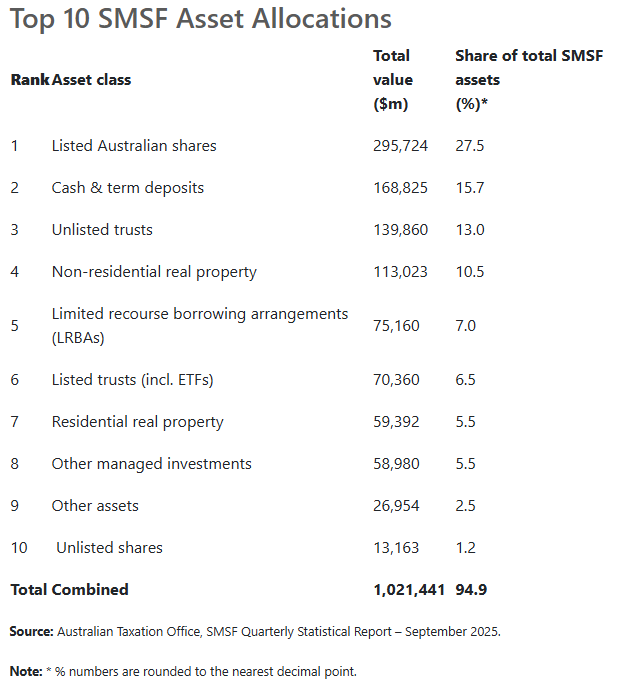
Listed shares continued to dominate SMSF portfolios, holding $295.7 billion (28%) of total SMSF assets in September 2025. Notably, this was effectively unchanged from the September 2024 quarter, when listed shares also accounted for 28% of total assets.For investors, the stability of this allocation is telling. It shows that trustees did not retreat from equities despite bouts of volatility over the past year. Instead, they appear to have been comfortable with maintaining equity exposure as portfolios expanded in absolute size. Even a static percentage allocation translates into meaningfully larger dollar exposure to equity markets as the SMSF asset pool grows. In aggregate, this cements SMSFs as a structurally important source of patient capital for Australian and global equities — particularly relevant for companies reliant on long‑term domestic ownership.
ETFs continue to reshape how equity exposure is implemented
While the ATO does not separately disclose exchange traded funds (ETFs), they are captured within listed trusts, a category that has shown some of the strongest growth over recent years.The ATO data indicates that funds in this category have expanded materially over the past five years, which supports the findings in the Vanguard/Investment Trends Self Managed Super Fund (SMSF) Report released in June last year.The report found there had been a significant shift by SMSF investors toward ETFs for diversification, cost efficiency and international exposure, with 51% of SMSFs (315,000 funds) holding one or more ETF products in their fund.Of these, 230,000 SMSFs indicated in the report they expected to reinvest in ETFs over the next 12 months, and a further 65,000 noted they planned to make their first ETF investment over the same period.For investors and product providers, the implication is clear: SMSFs are becoming more institutional in behaviour, increasingly favouring broad‑based market exposure alongside selective direct holdings.
Cash remains a buffer, not a strategy
Cash and term deposits remained the second‑largest asset class in SMSF portfolios in September 2025 ($168.8 billion), accounting for 16% of total assets — unchanged from a year earlier. Despite elevated interest rates, SMSF investors have not materially increased their reliance on cash.This suggests trustees are still prioritising long‑term real returns over short‑term yield, treating cash primarily as a tool for liquidity management, pension payments and risk control rather than as a core return driver.
Property exposure stays measured
Direct property — both residential and non‑residential — continued to form a significant but stable part of SMSF portfolios. The latest statistics show no material shift in property allocations over the year, despite ongoing commentary around rental supply shortages and higher rents. From an investor perspective, this reinforces the notion that SMSFs view property as a strategic, long‑duration asset, constrained by liquidity, valuation and regulatory considerations, rather than a cyclical opportunity.
A mature sector with growing influence
Taken together, the September 2025 data paints the picture of a sector that is large, stable and increasingly influential. Asset allocations are not swinging dramatically quarter to quarter, but total capital continues to rise, magnifying the impact of SMSF investment decisions across listed markets. Once deployed, SMSF capital tends to remain invested, reinforcing the sector’s role as a long‑term cornerstone of Australia’s investment landscape.