Sarah’s story
Introduction
As financial advisers, we spend a great deal of time helping people prepare for the future. We talk about retirement, investments, insurance and estate planning. Yet one of the most important conversations we have is often the one people are least eager to have—what happens if life doesn't go according to plan?
Over the years, Aspire Planning has helped more than 100 families put the right estate planning arrangements in place through our estate planning facilitation process. Every week we also help clients review their life insurance, not because we expect the worst to happen, but because we know that when life changes unexpectedly, preparation can make an enormous difference for those left behind.
Sarah's story is one of those reminders.
After unexpectedly losing her husband Mark, Sarah found herself navigating grief while simultaneously managing the practical realities that follow the death of a loved one. She wanted to share her experience, not to dwell on what happened, but in the hope that other families might have the conversations she and Mark eventually had—and perhaps avoid some of the challenges she encountered.
What follows is Sarah's story, told largely in her own words.
It is honest, deeply personal and, I believe, something every family can learn from.
Sarah’s story
“No one ever thinks anything bad is going to happen to them until it does.”
My husband Mark used to say this a lot. He served with Victoria Police for 30 years so had seen bad things happen often. Interestingly though, he didn’t have a Will until he was 51 years old, nor did I.
Wills
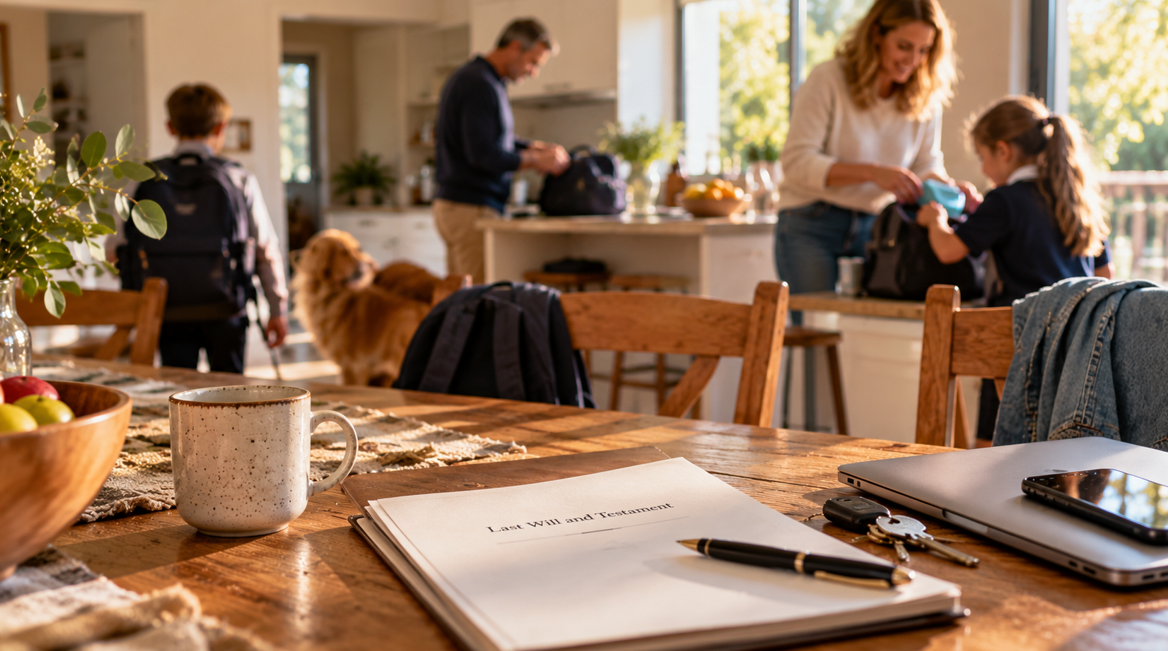
We started preparing our Wills when we were first married but then life just got in the way and we just never finished. Until one day, nearly 20 years later, I simply got sick and tired of having it on my to-do list, so I went to the local solicitors and just got them done.
Two years later to the day our Wills were signed, Mark unexpectedly died.
Preparing for our Wills made us have an uncomfortable conversation that many people don’t have, perhaps because they think they’re too young or it’s not going to happen to them.
· What would happen if one or both of us died?
· Who would raise our kids?
· What kind of funeral did we want?
· Cremation or burial?
· What to do with our ashes?
Some details were in the Will but not all - we kept it basic. I was fortunate that there was a Will as it made things easier, although not everything was straight-forward.
Naturally I was in shock when Mark died. Leaving aside the emotional turmoil, the financial shock hits hard and quickly too.
Mark’s income stopped the day he died and it would be some time for his final pay to come through. Straight away I needed money for the funeral and other related expenses.
Mark died interstate so he had to be transported back to Melbourne – this alone added more than $4,000 to the costs. Funerals are expensive. These unplanned significant expenses had to be paid upfront. I was very fortunate to receive immediate and generous support from the Police Association but it still didn’t cover half of the costs.
I started the legal/financial process fairly quickly after Mark died as this helped distract me from the overwhelming grief and I hoped it would ease my anxiety about our financial future.
I simply needed to know where we were at and that we were going to be ok.
Life Insurance
Mark didn’t have life insurance, and this thought sent me into a panic. It was an “opt-in” feature of his super fund – I don’t know why he hadn’t “ticked the box”, but I suspect it may have cost too much given the high-risk nature of his job. Maybe he thought he’d never need it.
Mark had been the primary breadwinner, and even though I was working, I had taken a 10-year career break to look after the children which had impacted my earning capacity and of course my super balance.
Solicitor / Probate
The first thing I did was to see the solicitor who held our Wills. The solicitor told me that we had a straight-forward Will - Mark had left everything to me and as most accounts were in joint names, including the house/mortgage, I would not require Probate.
Unfortunately, I later discovered the advice I received about Probate wasn't appropriate for my circumstances. At the time, I was told I didn't need Probate because our assets were straightforward and jointly owned. Acting on that advice ultimately created years of delays when dealing with the ATO over Mark's tax affairs.
I didn’t realise at the time, but their inaccurate advice meant a long and painful process with the ATO to finalise Mark’s tax returns. After more than 2 years, I’m still waiting for one of his refunds to be paid - I’ll get back to that later.
Looking back, had Probate been obtained from the outset, much of that frustration may have been avoided.
Financial Reality
I was fortunate that I generally managed the day-to-day finances, so I knew all the accounts we had and the passwords, etc. This meant I was able to move money between accounts so that I could support us.
Once the bank becomes aware of a death, the deceased’s accounts are immediately frozen. It can also take time to receive their final salary. And, I had to take time off work, which is another financial consideration.
It took nearly 2 months to receive Mark’s final pay, and his employer would only release it to a solicitor. This was given to our solicitor’s office who then, without warning, closed early for Christmas (this was 3-4 days before Christmas) holding on to the funds.
Here I was with three kids just before Christmas, and I hadn’t received Mark’s pay for nearly two months. I escalated it to one of the firm’s partners who eventually said she would transfer part of the money after Christmas, with the rest arriving in my account when they returned from holidays in mid-late January.
I’m not sure why. She then emailed me saying I needed to make an appointment to arrange an application for probate and sent me an invoice. I explained that her colleague had already told me I didn’t need to apply for Probate to which they replied, “Well, then the invoice is to cover our time for managing Mark’s final pay.” It was around $600. To simply bank a final pay cheque.
The next thing I did was to find a Financial Advisor to help me navigate what to do. At that point I wasn't looking for investment advice—I was looking for someone who could help me understand where we stood financially and whether my family was going to be OK.
Tim helped me step back from the immediate crisis, understand our position and build a plan for what life would look like over the coming years.
Dealing with Organisations
I just kept putting one foot in front of the other.
There were so many moving parts in my life, and my attention was constantly pulled in different directions.
I needed to write everything down - I basically had an evolving “to do list”. I needed to get through everything and make sure all my affairs were sorted in case something happened to me, and my kids were left to deal with it.
Using the government's checklist as a guide, I worked my way through banks, Medicare, the ATO, utilities, council, Titles Office, insurance companies and countless other organisations.
Each organisation had different processes, different forms and different requirements.
Most of the people I dealt with genuinely wanted to help, but every organisation had legal obligations and systems they needed to follow. When you're grieving, having to navigate all of those different processes can become exhausting.
Some experiences stay with me. Updating our Telstra account proved almost impossible because it was in Mark's name. I couldn't simply change the details—I had to become a completely new cusMarker.
I cancelled future travel plans – we had flights booked 4 months after he died and when I rang to cancel, the airline’s rep insisted on providing Mark with a credit for future travel. I asked, “And how is he supposed to use that credit? He’s dead.” It was escalated to their manager. I then had to arrange a Stat Dec and provide a certified copy of the death certificate to obtain a refund.
I do understand these processes are in place for a reason, but it’s often a cruel process for the bereaved. Some institutions handled it reasonably well; others didn’t. I remember one bank phone operator ending the call with “I’m sorry for your loss. Chin up!” Did she actually just say that? Um, yeah, ok, I’ll try…
ATO
The ATO process became the longest and most frustrating experience of all. Because Probate hadn't initially been obtained, Mark's tax refunds were delayed for years while I worked through multiple applications and jurisdictions before finally obtaining Probate and resubmitting everything.
Finally, Mark’s Tax Returns were paid. Strangely one was paid directly via EFT into my bank account, but the other was paid via a cheque to “The estate of Mark.” I took the cheque to my bank. They couldn’t help me on the spot and said they couldn’t cash a cheque that wasn’t in my name but took copies and said someone would contact me. It took another 8 weeks to resolve.
Apple
Another important thing I had to deal with was his phone. Mark hadn’t backed up his photos for 5 years and didn’t trust the Cloud. I didn’t know his passcode, and Apple will not help you get into an iPhone that isn’t yours.
I was devastated to think 5 years of family videos and photos were going to be lost. At the time, I considered using his fingerprint, but this only works for 2 days. After that you need the passcode to access the phone.
I tried various options, but nothing worked. A year later, a miracle happened. I knew his Apple ID and his login password for our joint Macbook. I logged in and changed his iCloud settings, then plugged his phone into the laptop and suddenly all his photos appeared in the Cloud.
I had tried doing this previously, but it hadn’t worked. I truly believe there was a divine intervention that day!
Through this experience I learned that you could nominate a Legacy Contact within your Apple account that gives loved one's access to your photos if you are deceased. Our family now has this set up.
Lessons
In summary, what I’ve learned is:
· Think about what you want to happen when you die. Talk about it with your spouse or kids. Don’t wait. We don’t all have the privilege of growing old.
· Be prepared. Have a Will, POA and Medical POA and make sure that it is set up correctly for your circumstances, e.g. testamentary trusts, etc. The last thing you want to do is put your loved ones through more stress at what is an incredibly difficult time.
· If relevant, protect your estate and your kids’ inheritance with a Testamentary trust.
· Don’t just set and forget. Life changes. Every so often review your Will and POA.
· Let those you trust know where things are or where they can find the info – bank accounts, shares, investments, code to the safe, etc, tell your Executor.
· If you can, set some $ aside just in case you need it for a rainy day.
· Nominate Legacy contacts for your phone account.
And when you lose a loved one the biggest advice I can offer is this:
Be kind to yourself.
Take your time.
Don't feel pressured to make big decisions immediately.
Take one step at a time. (I found Dr Lucy Hone’s book, Resilient Grieving very helpful, and as a starting point continually asked, “Is this helping me or harming me?”)
Ask for help from people you trust.
Keep good records and obtain plenty of certified copies of documents—you'll use more than you think.
If you're working through the administration yourself, don't be afraid to ask questions. Most organisations genuinely want to help, even though their processes can sometimes feel overwhelming.
- There is a free government service that can help let organisations know someone has died https://deathnotification.gov.au/
Seek help, advice and referrals from trusted people
Postscript
Reading Sarah's story, it's clear that no amount of planning can remove the grief of losing someone you love. What good planning can do, however, is remove unnecessary uncertainty and make a difficult time a little more manageable.
One of the themes that stood out to me wasn't that individual organisations or professionals got everything right or wrong. It was that, after a death, families often find themselves dealing with many different organisations—banks, government departments, insurers, employers, utilities and more. Each has its own responsibilities, legal obligations and processes, and understandably they can't always see the bigger picture of what a grieving family is experiencing.
That is why preparation matters so much.
Having an up-to-date Will, appropriate Powers of Attorney, the right life insurance, and making sure the important people in your life know where key information can be found won't remove the pain of losing someone. But it can remove many of the avoidable complications that add to an already overwhelming time.
If Sarah's story encourages just one family to have those conversations a little earlier, review their estate plan or think more carefully about the financial protection they have in place, then sharing her experience will have achieved exactly what she hoped it would.
— Tim Henry, Aspire Planning