

How to start the aged care conversation with your family
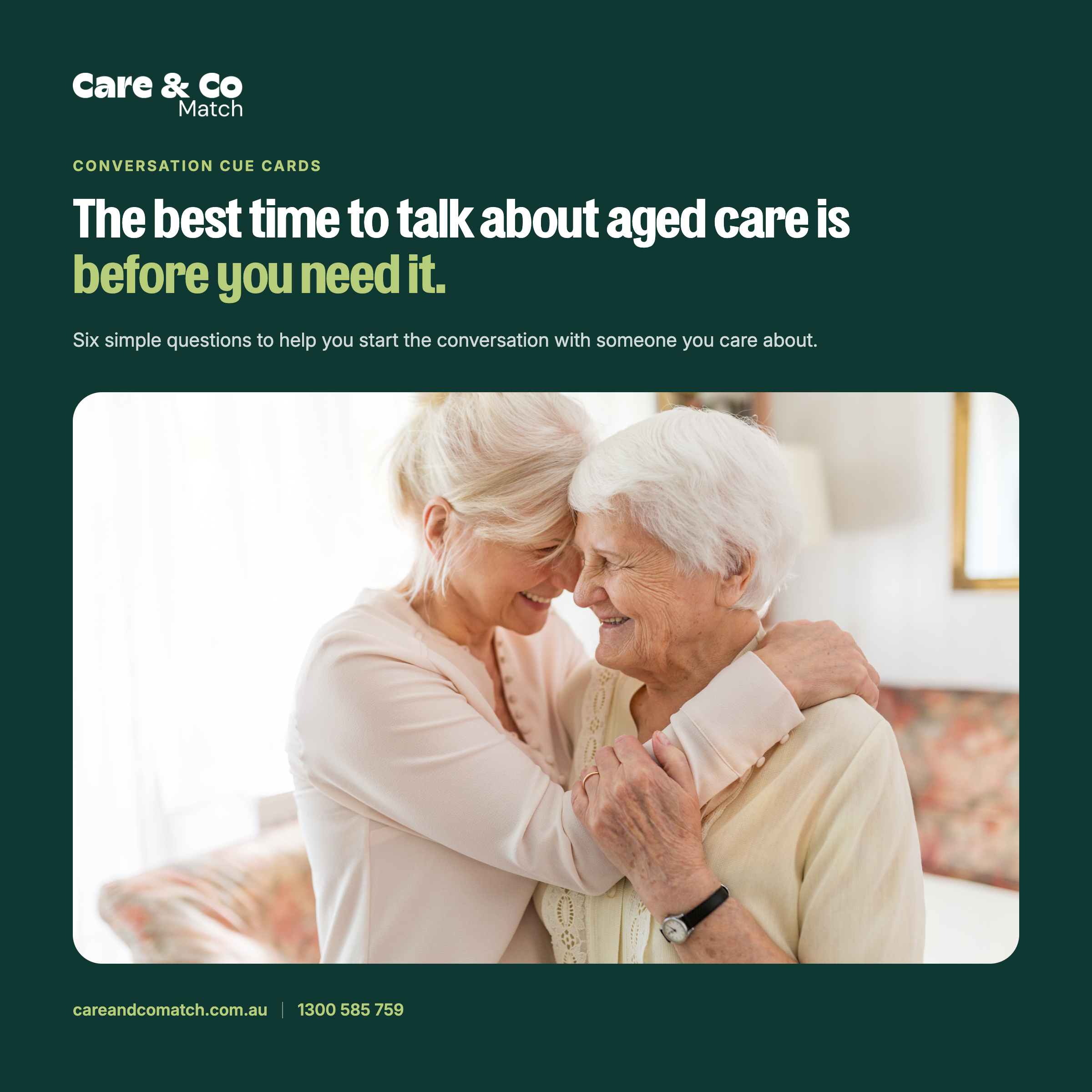
How to start the aged care conversation with your family
Talking about aged care with someone you care about isn’t always easy.
You might be worried about an ageing parent, grandparent, partner, relative, friend or another important person in your life. Perhaps you’ve noticed a few changes, or maybe everything is going well and you simply want to understand what they would want in the future.
Either way, it can be difficult to know how to bring it up.
The good news is that talking about aged care doesn’t mean making decisions about care. Starting early can simply mean understanding someone’s wishes, talking about what matters to them and knowing what options are available if circumstances change.
Why have the conversation before care is needed?
Many families first start thinking seriously about aged care after something happens.
It might be a fall, a hospital stay, a change in health or the realisation that everyday tasks are becoming more difficult. Suddenly, decisions that could have been considered over months need to be made in days.
Starting the conversation earlier can take some of that pressure away.
It gives your loved one more opportunity to express what they want, allows everyone involved to understand their preferences and gives you time to explore different options without having to make an immediate decision.
Most importantly, talking about the future doesn’t mean someone is losing their independence. Planning ahead can actually help protect it.
Choose the right moment
You don't necessarily need to organise a formal family meeting or announce that it's time to “talk about aged care”.
Often, the easiest conversations happen naturally.
Perhaps someone you know has recently started receiving help at home. You might be
discussing future plans, noticing that something around the house is becoming more
difficult, or talking about what another family has experienced.
These everyday moments can provide an opportunity to ask a simple question and see
where the conversation goes.
Start with questions, not solutions
It can be tempting to enter the conversation with an answer already in mind:
“I think you need some help at home.”
But this can make someone feel as though decisions are being made for them.
Instead, start by asking how they feel.
You could try:
● “How are you finding things at home lately?”
● “Is there anything that's becoming harder than it used to be?”
● “What would make things a little easier for you?”
● “What's most important to you about staying independent?”
● “If you ever needed some extra help, what would you want that to look like?”
● “Would you like us to look at what's available, just so we know?”
You may be surprised by what you learn.
Listen before trying to fix anything
The first conversation doesn't need to end with a plan.
Your loved one may not be ready to talk about support. They may have concerns about
losing independence, leaving their home, cost or having unfamiliar people involved in
their life.
Listen to those concerns rather than immediately trying to solve them.
Understanding what someone doesn't want can be just as valuable as understanding
what they do want.
And remember, aged care support doesn't automatically mean moving into residential
care. Depending on someone's needs, there may be options to help them remain safely
and independently at home for longer.
Keep the focus on what matters to them
Aged care conversations can quickly become focused on services, assessments and
logistics.
Try to bring the conversation back to the person.
What matters most to them?
It might be staying in their own home. Remaining close to family and friends. Keeping a
pet. Continuing to attend a local club. Living near the beach. Having help with the garden.
Maintaining cultural or community connections.
These preferences can become important when considering support later.
Don't expect to solve everything in one conversation
You might raise the subject and get a very clear response:
“I don't want to talk about that.”
That's okay.
Unless there's an immediate safety concern, you don't have to push for a decision.
Aged care planning is often a series of conversations rather than one big discussion.
Introducing the topic now can make it much easier to return to later.
You could simply say:
“That's fine. I just wanted to understand what you'd want if things ever changed.”
Then leave the door open.
Take one practical step
If the conversation goes well, you don't need to immediately start making major decisions.
Choose one small next step.
That might be finding out what support is available at home, understanding how My Aged
Care works, discussing preferences with other family members, looking into an
assessment or simply writing down your loved one's wishes.
You can explore the options without committing to them.
You don't have to understand aged care before starting the conversation
Australia's aged care system can be complicated. There are different types of care,
eligibility requirements, assessments, funding arrangements and providers to navigate.
You don't need to understand all of that before talking to someone you care about.
Start with the person, not the system.
Understand what matters to them, what might be changing and what questions you have.
The practical details can come next.
Not sure what the next step should be?
Sometimes the hardest part isn't starting the conversation - it's knowing what to do
afterwards.
Care & Co Match can help you understand the options available and identify practical next
steps based on your loved one's circumstances, needs and preferences.
Through Care & Co Match, you can speak one-on-one with a Care Concierge about your
situation, questions and options. Your Care Concierge can also undertake targeted
research to help you understand what to do next.
Because when it comes to aged care, you don't need to have all the answers.
Sometimes, you just need to start the conversation.
How to access Care & Co Match:
If you’re not sure what comes next, speak with your financial adviser about connecting
you with Care & Co Match for independent, personalised guidance and support.
Alternatively, call 1300 585 759 or email concierge@careandcomatch.com.au