

AI and money decisions

Using publicly available, general-purpose artificial intelligence (AI) for money questions? Learn when it can help, and when you should get more information.
If you’ve ever asked AI a money question, you’re not the only one. More Gen Z Australians (those born between around 1996 and 2010) are using AI tools alongside social media and online content to understand money. These tools can make financial information feel quicker and easier – but that doesn’t always mean it’s accurate or right for you.
Knowing how to use AI tools (for example, ChatGPT, Claude and Gemini) responsibly can help you stay in control of your money decisions.
How AI can help with money questions
AI can be useful when you treat it as a learning tool, not a decision-maker.
For example, it can:
Break down complex information. AI can quickly analyse and summarise massive amounts of data or technical information so you can understand the big picture faster.
Answer simple questions. ‘What’s compound interest?’ ‘What’s an overdraft?’ – AI can give you a simple explanation without the need to spend lots of time on a deep dive.
Point you in the right direction. AI can suggest what topics to research next, based on the information you give it.
Highlight market trends. It can help track general market trends or explain what’s happening in the economy. Overall, think of AI as a friendly commerce or business studies teacher. Someone you can ask lots of general questions about money and finance, but not someone to go to for stock tips or for making financial decisions.
What to consider if you use AI
AI is powerful but it has limits – especially when it comes to money.
Be careful about:
relying on AI to tell you what to invest in or giving you other financial advice
following a specific financial strategy suggested by AI or a finfluencer
making big money decisions without understanding the risks.
Here’s why.
Like humans, AI can be wrong. AI tools can produce inaccurate or biased information. Relying on them alone, especially for investing, can lead to decisions that end badly.
AI doesn’t really know you. AI only knows what you tell it and most AI systems haven’t been trained on what questions to ask to provide good advice. AI is unlikely to understand your full financial situation, goals or risk tolerance.
AI isn’t licensed. AI platforms are generally not licensed to give personal financial advice. They can explain concepts, but unless they are licensed they can’t legally tell you what’s right for you. Remember - anyone who gives personal financial advice and most general advice providers must have an Australian financial services (AFS) licence.
Privacy matters. Using AI sometimes means sharing personal information. Always think about how your data is collected, stored and used. As with all online interactions, keep your personal information safe and don’t share what you don’t need to. This includes your date of birth, address, email, and financial information.
They’re general-purpose tools. General purpose AI tools (e.g. Chat GPT, Claude, Gemini) have not been designed for giving financial advice and may have big gaps in their knowledge about important things like tax or superannuation.
How to ask better questions (and get better answers)
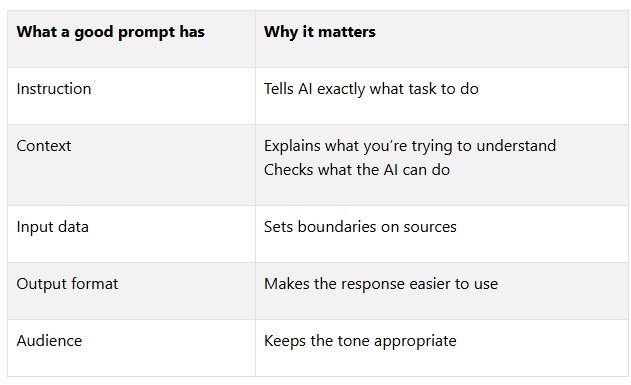
AI works best when you’re clear about what you want. Think of it like giving directions. Vague questions lead to vague answers.
So, when it comes to asking questions, give AI some guidelines and guardrails to work with. Digital NSW offers the following chatbot prompt guidelines.
Make decisions that are right for you
AI can help you learn, but it can’t take responsibility for your decisions.
Before acting on information from AI or online sources:
check it against trusted, independent sources
understand the risks involved
remember that the final decision is yours.
Financial decisions are complex. AI tools aren’t a shortcut, and they’re not a substitute for careful research or professional advice.
Use AI to get informed. Then take the time to verify the claims and make decisions that are right for you.
Reproduced with the permission of ASIC’s MoneySmart Team. This article was originally published at https://moneysmart.gov.au/online-safety/ai-and-money-decisions
Important note: This provides general information and hasn’t taken your circumstances into account. It’s important to consider your particular circumstances before deciding what’s right for you. Although the information is from sources considered reliable, we do not guarantee that it is accurate or complete. You should not rely upon it and should seek qualified advice before making any investment decision. Except where liability under any statute cannot be excluded, we do not accept any liability (whether under contract, tort or otherwise) for any resulting loss or damage of the reader or any other person. Past performance is not a reliable guide to future returns.
Important
Any information provided by the author detailed above is separate and external to our business and our Licensee. Neither our business nor our Licensee takes any responsibility for any action or any service provided by the author. Any links have been provided with permission for information purposes only and will take you to external websites, which are not connected to our company in any way. Note: Our company does not endorse and is not responsible for the accuracy of the contents/information contained within the linked site(s) accessible from this page.